UAE VAT Registration: AED 375,000 Mandatory, AED 187,500 Voluntary
When a UAE business must register for VAT, when it may choose to, how the 12-month and 30-day tests work, the 30-day deadline, what freelancers do, and a worked example from the course.
Two numbers decide VAT registration in the UAE: AED 375,000 and AED 187,500. Above the first, registration is compulsory. Above the second, it is a choice. Getting the test right, and registering on time, is one of the first jobs a junior at a UAE tax firm is trusted with.
Mandatory registration: AED 375,000
A business must register for VAT once its taxable supplies and imports exceed AED 375,000. The test is applied two ways, and either one triggers registration:
- Looking back: taxable supplies and imports over the previous 12 months are above AED 375,000.
- Looking forward: they are expected to exceed AED 375,000 in the next 30 days.
Voluntary registration: AED 187,500
Below the mandatory threshold, a business may register voluntarily once its taxable supplies and imports, or its expenses, exceed AED 187,500. Expenses count here, which matters for a new business that has spent heavily before earning much.
Voluntary registration is a real strategic choice: once registered, the business can recover the input VAT on its costs straight away rather than waiting until it crosses AED 375,000. The trade-off is that it must charge VAT on its sales and file returns from then on.
The deadline: 30 days
The application is due within 30 days of the registration obligation arising. Late registration carries an administrative penalty, and the FTA treats late registration, late filing and late payment as three separate failures, each with its own penalty.
Penalty amounts are set in the official tables (for VAT, Cabinet Decision No. 40 of 2017 as amended) and are revised from time to time, so check tax.gov.ae before quoting a figure to a real client.
What counts towards the threshold
Only taxable supplies and imports count. Exempt supplies do not: in the course, Thomas rents out flats and a shop, and only the shop rent counts, because residential rent is exempt. Zero-rated supplies, on the other hand, are taxable at 0% and do count, so an exporter of services can cross the threshold even though it charges no VAT.
Freelancers register as individuals
VAT is charged by the person making taxable supplies, whether that is a company or an individual. A freelancer or sole trader whose taxable supplies pass AED 375,000 in the previous 12 months registers as a natural person, under the name on their licence.
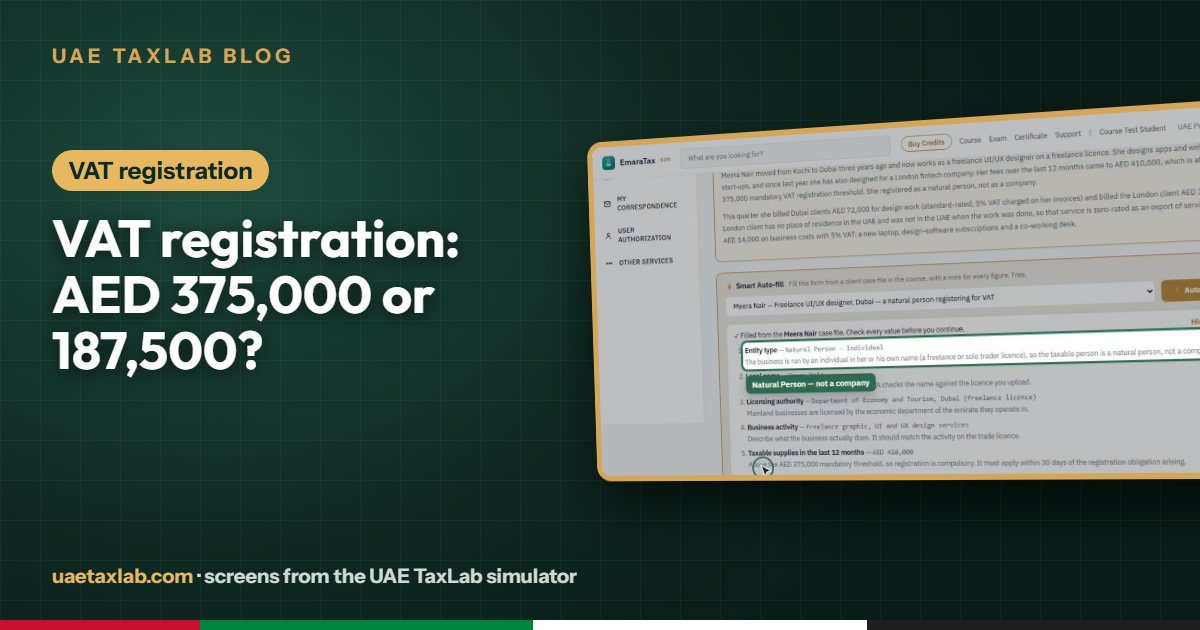
In chapter 4 of the UAE TaxLab story course, Meera Nair, a freelance designer in Dubai, earned AED 410,000 in the last 12 months. That is above AED 375,000, so registration is compulsory and she has 30 days to apply. She registers as a natural person, and her work for a London client with no UAE presence goes on her returns as zero-rated.
Worked examples
Four quick cases, using only the rules above:
- A trading company with AED 420,000 of taxable sales in the last 12 months: above AED 375,000, so it must register within 30 days.
- A start-up with AED 60,000 of sales but AED 200,000 of taxable expenses on fit-out and equipment: below the mandatory threshold, but its expenses exceed AED 187,500, so it may register voluntarily and recover the input VAT.
- A landlord with AED 500,000 of residential rent and AED 100,000 of shop rent: only the AED 100,000 counts, so registration is not required on these figures.
- A consultancy that signs a contract worth AED 400,000 to be billed this month: expected to exceed AED 375,000 in the next 30 days, so it must register now, not after the invoice.
After registration
The FTA issues a Tax Registration Number (TRN) and assigns a filing frequency. As a standard rule, businesses with annual turnover below AED 150 million file quarterly and those at or above it file monthly, though the FTA can assign a different period. Whatever the period, each VAT return and payment is due 28 days after the period ends.
If a business later stops making taxable supplies, or its turnover stays below the voluntary threshold, it applies to de-register, generally within 20 business days of the de-registration event.
Practise it
In UAE TaxLab you register Meera for VAT on a practice EmaraTax portal, with Smart Auto-fill filling the wizard from her client file and a note explaining each value, including the threshold test. Chapters 1 to 4 are free. UAE TaxLab is an educational simulation, not the FTA portal, and is not affiliated with the Federal Tax Authority.
UAE tax course · Study notes · Tax calculators · Blog · Pricing